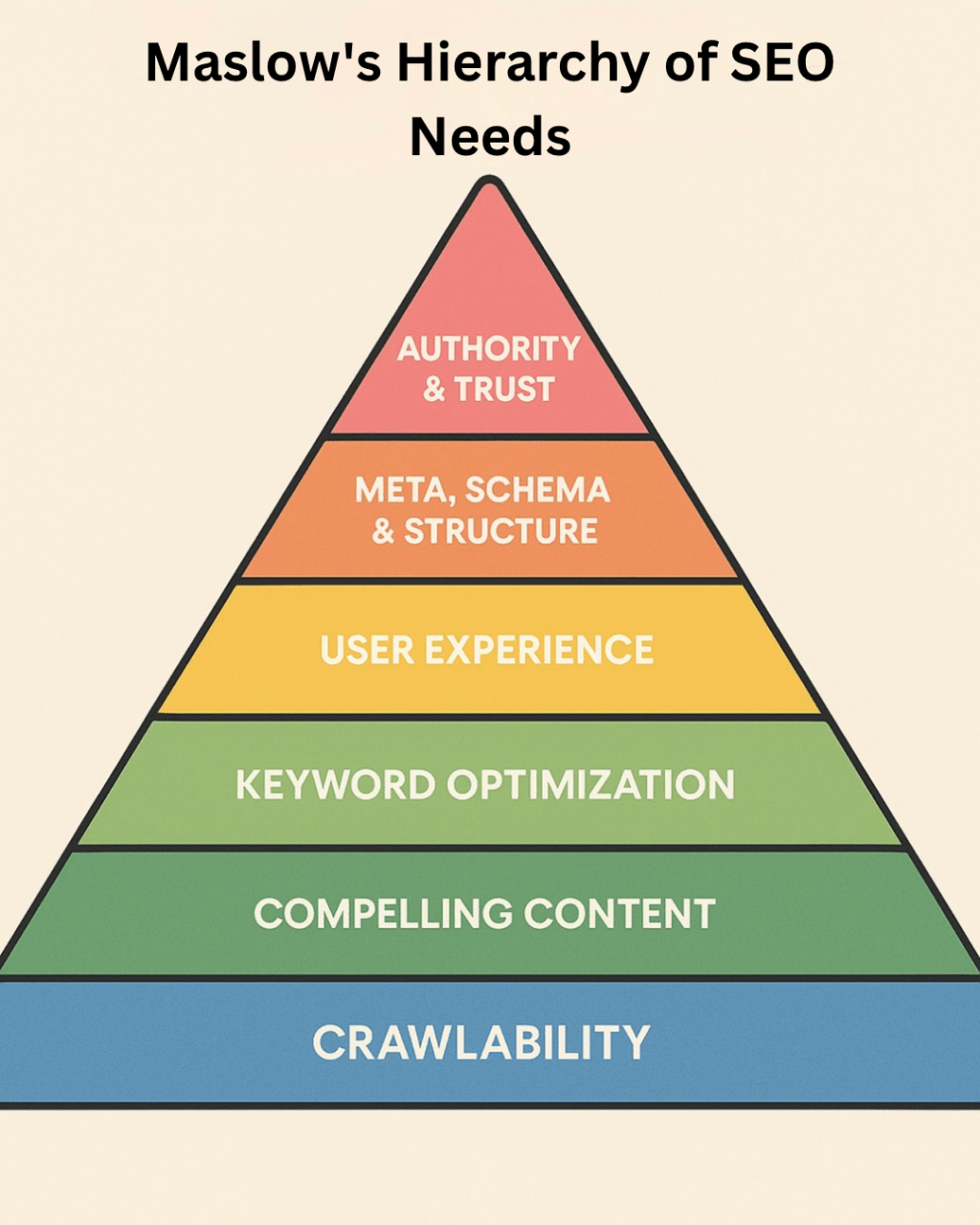
Think of it like this: You wouldn’t try to run a marathon without first learning to walk, would you? The same logic applies to your website’s success in the vast digital landscape. Just as humans require fundamental needs to be met before they can achieve self-actualisation, your website needs a robust SEO foundation before it can even dream of conquering those highly competitive keywords.
Maslow’s Hierarchy of SEO Needs: Your Blueprint for Ranking Success
If the renowned psychologist Abraham Maslow had pivoted to become an SEO strategist, he would undoubtedly have gifted us with Maslow’s Hierarchy of SEO Needs. This model, in our humble opinion, is the most accurate framework for truly understanding what drives search engine rankings. It’s a pyramid, with each level building upon the one below it, ensuring a solid base for growth.
Here’s how the pyramid breaks down:
Crawlability: The Absolute Base
At the very bottom, forming the bedrock of your SEO efforts, is Crawlability. Simply put, if Google cannot find and access your website’s pages, then absolutely nothing else matters. All your brilliant content and clever optimisation will be invisible. This means ensuring your robots.txt file is correctly configured, your sitemap is submitted, and there are no technical barriers preventing search engine bots from exploring your site. It’s the digital equivalent of ensuring your front door is open for visitors.
Compelling Content: The fuel for engagement.
Once Google can find you, the next crucial step is Compelling Content. This isn’t just about having words on a page; it’s about providing real value, genuinely answering your audience’s questions, and being truly relevant to their needs. Think in terms of in-depth guides, insightful blog posts, engaging videos, and anything that keeps users on your site, absorbing information. This is your website’s nutrition, keeping it strong and vibrant.
Keyword Optimisation: Speaking Their Language
With great content in place, you move to Keyword Optimisation. This is about understanding and speaking your audience’s language, meticulously matching their search intent. It involves thorough keyword research to identify what terms your potential customers are using, and then strategically integrating those keywords naturally within your content, headings, and meta descriptions. It is how you signal to search engines that your content is precisely what a user is looking for.
User Experience: Smooth Sailing for Visitors
The fourth level is User Experience (UX). A fast, mobile-friendly, and easy-to-navigate website isn’t just a nice-to-have; it’s a non-negotiable for search engine success. Google heavily prioritises websites that offer a seamless experience to their users. Slow loading times, a confusing layout, or a non-responsive design will send visitors scrambling and signal to Google that your site isn’t providing the best experience. Think of it as providing a comfortable and welcoming environment for your visitors.
Meta, Schema & Structure: Guiding Search Engines
Moving up the pyramid, we encounter Meta, Schema & Structure. This layer is all about helping search engines understand your content more deeply. This includes well-crafted meta titles and descriptions that entice clicks, implementing schema markup to provide context to your data, and ensuring a logical site structure with clear internal linking. It is like providing clear signposts and a detailed map for search engines to follow.
Authority & Trust: The Pinnacle of SEO Self-Actualisation
Finally, at the very top, is Authority & Trust, leading to SEO self-actualisation. This is earned through high-quality backlinks from reputable sources, a strong brand presence, and demonstrating deep topical expertise. It is the culmination of all the previous efforts, signalling to search engines that your website is a reliable, credible, and definitive source of information within your niche. This is where your website truly shines and dominates its space.
The Common, Costly Mistake
Here’s the kicker: A common and incredibly costly mistake many website owners and SEOs make is chasing backlinks (the very top of the pyramid) while completely ignoring critical crawl issues or producing thin, uninspired content (the foundational levels). That’s akin to trying to thrive without eating or sleeping! You simply cannot build a sustainable, high-ranking website on a shaky foundation. It’s an exercise in futility that wastes valuable time and resources.
Time for an SEO Check-Up?
Next time your rankings inexplicably drop, or your organic traffic stagnates, take a deep breath and ask yourself this crucial question:
👉 Which level of Maslow’s pyramid am I really working on right now?
Focus on strengthening the lower levels before you reach for the top. Your website, and your rankings, will thank you for it.